- Home
- ABOUT US
- THE SPLASH! 2026 NOTES
- THE MISSION BLOG
- MISSION STATISTICS
- FOUNDER'S MESSAGE
- TRUTH AND RECONCILIATION
- EXPERIENCE THE MISSION
- MISSION, VISION, VALUES
- REPLICATE THE MISSION!
- THE REPLICATION GUIDE
- REPLICATION PLAYBOOK
- LESSONS LEARNED
- CONTACT US
- VOLUNTEER SAFETY INFO
- WORLD WATER DAY
- EVENTS
- ST ANDREW'S PRESBYTERIAN
a simple idea that other communities can adapt

In Canada people are living without access to water due to system failure
Across Canada, people experiencing homelessness and living in encampments are routinely without access to clean drinking water, sanitation, and basic survival necessities. This is not an isolated issue, but a nationally documented human rights gap.
I WAS THIRSTY began in Thunder Bay with a simple question: are people living outdoors able to reliably access safe drinking water?
The answer led to a small pilot project in 2025 and, over two operating seasons, to the development of a structured direct-delivery model supported by volunteers, donors, community partners, and careful daily evaluation.
What we have learned in Thunder Bay may be useful elsewhere.
We do not believe that every community faces the same circumstances, or that one model can simply be copied from place to place. Local needs, geography, available services, climate, transportation, funding, and community relationships all matter.
What we can share is our experience.

A FIELD TESTED THUNDER BAY MODEL
Water insecurity in Canada exists both in remote Indigenous communities and in urban encampments, revealing a broader systemic failure to ensure equitable access to a basic human necessity.
The I WAS THIRSTY model has been developed and refined through direct outreach in Thunder Bay.
It is intentionally simple:
- identify an unmet need;
- listen to the people affected;
- establish safe and reliable delivery;
- build consistent routes;
- work with local partners;
- protect the dignity and privacy of the people served;
- keep simple operational records;
- review each delivery day;
- adjust when circumstances change; and
- remain focused on the need the mission was created to address.
The approach does not require a large organization or complicated infrastructure. It does require committed volunteers, dependable transportation, a safe water supply, clear operating practices, local relationships, and a willingness to learn.

THE BOTTOM LINE
This report confirms:
- Water insecurity is real, widespread, and documented across Canada
- It disproportionately affects:
- Homeless populations
- Encampment residents
- It is best understood as:
- A human rights issue
- A service delivery failure
- A gap that can be immediately mitigated
https://www.chrc-ccdp.gc.ca/publications/putting-people-first#section_5_1
YOU CAN HELP
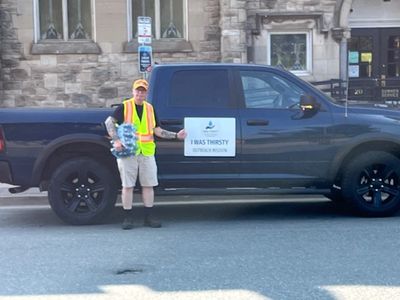
START WITH THE NEED
You can replicate this mission in your community.
We will show you how.
Before beginning a water outreach programme, we encourage communities to first determine whether a genuine gap exists.
People experiencing homelessness may already have access to drinking water through shelters, outreach agencies, public facilities, community organizations, or other services. In some communities, another need may be more urgent.
A successful local response begins by asking questions, listening, and understanding what already exists.
The goal should never be to duplicate good work.
The goal is to identify a gap and determine whether a simple, practical response can help.
LOCAL LEADERSHIP MATTERS
I WAS THIRSTY is not intended to become a network of branches controlled from Thunder Bay.
We believe the strongest community responses are locally led.
Our role is to share what we have learned, including the practices that worked, the mistakes we made, the questions we learned to ask, and the tools we developed along the way.
Communities are encouraged to adapt those resources to their own circumstances, local partnerships, and operating environment.
What works in Thunder Bay may look very different in another community.
That is not a weakness of the model.
It is part of the model.
WHAT WE CAN SHARE
To help other communities explore whether this type of outreach could work locally, I WAS THIRSTY has developed practical resources based on our experience.
These include:
- a Replication Guide;
- an operational Playbook;
- route-planning considerations;
- volunteer and safety practices;
- daily tracking and evaluation tools;
- basic budgeting considerations;
- recipient privacy and dignity principles;
- partnership ideas; and
- lessons learned from two operating seasons.
These resources are offered freely as a starting point.
MEASURE, LEARN, ADJUST
One of the most important lessons from Thunder Bay has been the value of simple, consistent evaluation.
Each delivery day provides new information.
Routes change. Encampments change. Demand changes. Volunteers become available or unavailable. New locations emerge. Other services may expand or change.
At the end of each delivery day, we review what happened and use that information to prepare for the next day.
The same principle applies to replication.
Start small. Measure what happens. Listen. Learn. Adjust.
A community does not need to have every answer before beginning, but it should have a safe plan, clear boundaries, reliable partners, and a willingness to improve.
DIGNITY COMES FIRST
The people receiving water are not statistics, projects, or problems to be solved.
They are neighbours.
Any community adapting this work should place dignity, privacy, respect, and voluntary engagement at the centre of its outreach.
Our experience has shown us that a bottle of water can open a conversation, but the conversation matters too.
Listen.
Learn names.
Respect boundaries.
Do not make assumptions.
Come back when you say you will.
COMPLEMENT, DON’T COMPETE
Water outreach should complement existing community services, not compete with them.
Before launching, we encourage communities to connect with shelters, outreach teams, municipalities, Indigenous organizations, churches, health providers, emergency services, and other groups already doing frontline work.
These conversations can help identify gaps, avoid duplication, improve safety, and build stronger local partnerships.
WHAT SUCCESS LOOKS LIKE
Success does not necessarily mean creating a large organization.
It may mean that people who previously struggled to access drinking water can now rely on a consistent local response.
It may mean that volunteers and community partners understand the need more clearly.
It may mean that another organization eventually becomes better positioned to provide the service.
And it may mean that a small group of people simply chooses to show up, reliably and respectfully, because a need exists.
INTERESTED IN ADAPTING THE MODEL?
If your community is exploring water insecurity among people experiencing homelessness, we are happy to share what we have learned in Thunder Bay.
Begin with the Replication Guide and Playbook, speak with local organizations, and determine whether there is a genuine gap that needs to be addressed.
If the model is appropriate for your community, adapt it.
Make it local.
Make it safe.
Measure what you do.
Learn as you go.
And most importantly, keep the focus on the people you are there to serve.
ONE BOTTLE OF WATER. ONE PERSON AT A TIME.
The idea behind I WAS THIRSTY has always been simple.
When a basic need exists, ordinary people can choose to respond.
Our hope is not that every community creates another I WAS THIRSTY.
Our hope is that communities will look carefully at the needs around them, use what is helpful from our experience, and build responses that make sense where they live.

We have shown that a small, volunteer-led initiative can deliver measurable, immediate impact addressing water insecurity among vulnerable populations.
With minimal cost and infrastructure, the I Was Thirsty model has been field tested, is measurable, scalable, and adaptable—demonstrating strong potential for replication in communities across Canada.